
The Ahoms
Siu-ka-pha, the founder
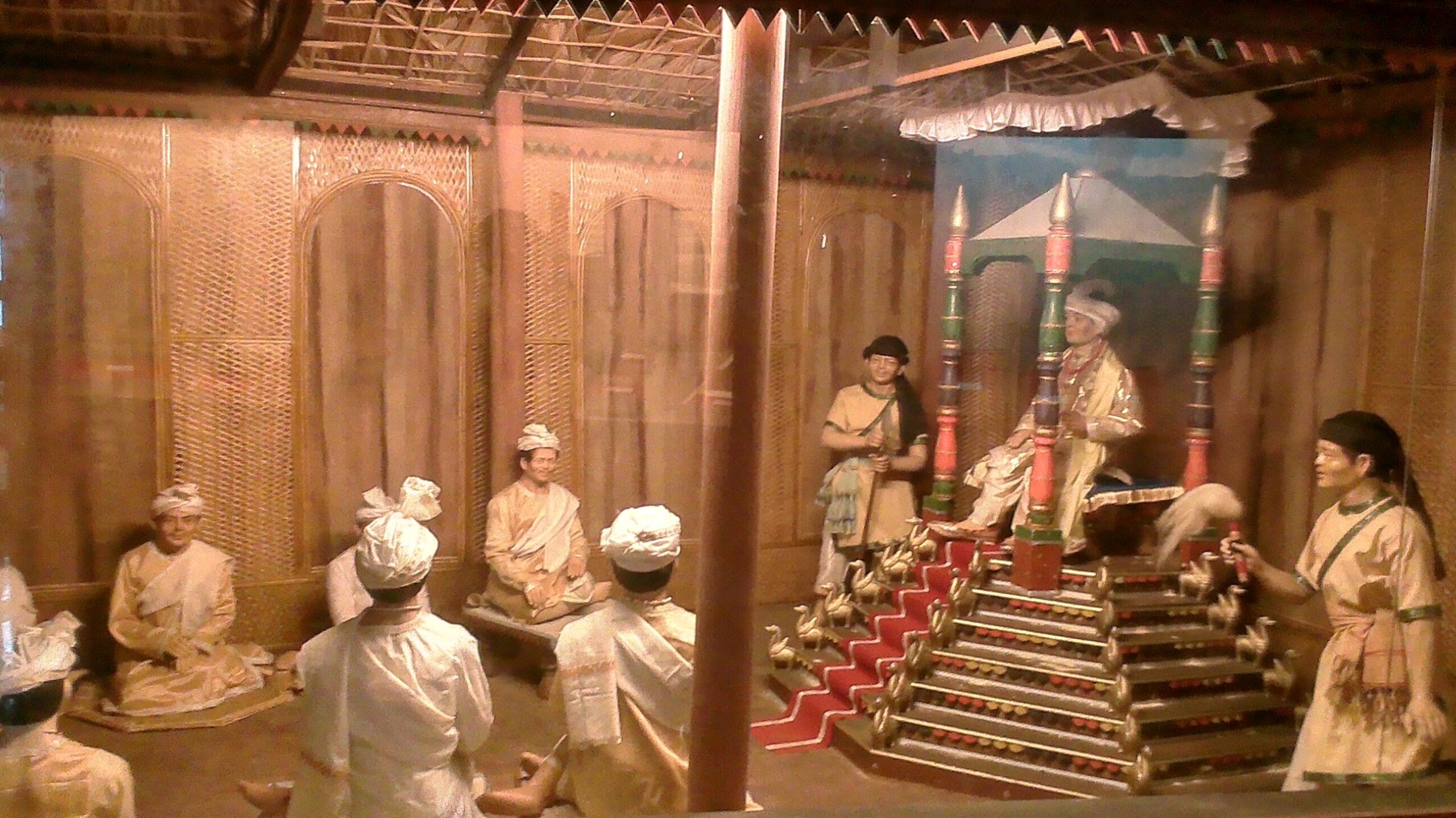
The glorious rule of successive kingdoms of Pragjyotisha-Kamarupa began to fade away by the middle of the 13th century CE. The Brahmaputra Valley in particular was soon divided into a number of small principalities, with the Chutiya, Barahi and Kachari dynasties ruling over different territories in eastern Assam. A number of Bhuyan chiefs on the other hand controlled their respective principalities in central Assam. It was exactly in 1228 CE that Siu-ka-pha, a Tai prince from Mong-Mao in the Shweli Valley in Yunnan, southern China, arrived in the Brahmaputra Valley after undertaking an arduous journey lasting nearly thirteen years. He was brought up with the hope that he would inherit the Mong Mao throne since Pa-Meo-Pung, his maternal uncle, had no male issue. But, as a son was born to the queen after 18 long years, and as the king died soon thereafter and the new-born prince was raised to the throne of Mong Mao, Siu-ka-pha decided to leave. Having consulted the officials and nobility, Siu-ka-pha moved towards Mong Pa-Kam, or the Bramaputra valley in 1215 CE to found a new state.
Sui-ka-pha is said to be a descendant of none other than Lengdon, the Lord of Heaven, who had in the distant past, sent down Khun-lung and Khun-lai, two brothers who were his grandsons, to found a dynasty on earth. Lengdon had also given them an idol called Chum Pha rung-seng-mong, commonly referred to as Chom or Somdeo, and Sheng or Shengdeo in Assamese accounts, with instructions to preserve them with utmost care. It is believed that it was because of this precious possession and the reverence shown to it that the Ahom kingdom prospered and lasted for six hundred glorious years.
Siu-ka-pha had brought along with him eight nobles, nine thousand “fighting men”, three hundred horses and two elephants, besides the sacred idol of Chum Pha rung-seng-mong, the tutelary family deity. On the personal front, his three wives, two sons and a daughter had also accompanied him in this laborious journey. They trekked over 1120 km through Myitkina, Moguang, and Hokwang, crossed the Doi-Kao-Rang or Patkai range, and reached the Brahmaputra Valley through the Shan states of northern Myanmar. At least five mong (state or dependencies) chiefs joined Siu-ka-pha with their contingents, some also with their families. Though there were a few resistances on the way, in most places the locals submitted to his
authority as they found under him greater peace and safety. Within present-day Myanmar, on the eastern side of the Patkai, he had also established a kingdom called Khamjang. Historical evidence show that there had been an old route from south-western Yunnan to Assam, and that the Tais possessed knowledge of the topography of the route which Siu-ka-pha took.
Having completed his long expedition in thirteen stages, Siu-ka-pha finally crossed the Patkai and marched downhill and reached the Nam-ruk river, from where he proceeded to its confluence with the Burhi-dihing, and made his first settlement at a place that came to be known as Tipam.
From Che-rai-doi to Charaideo
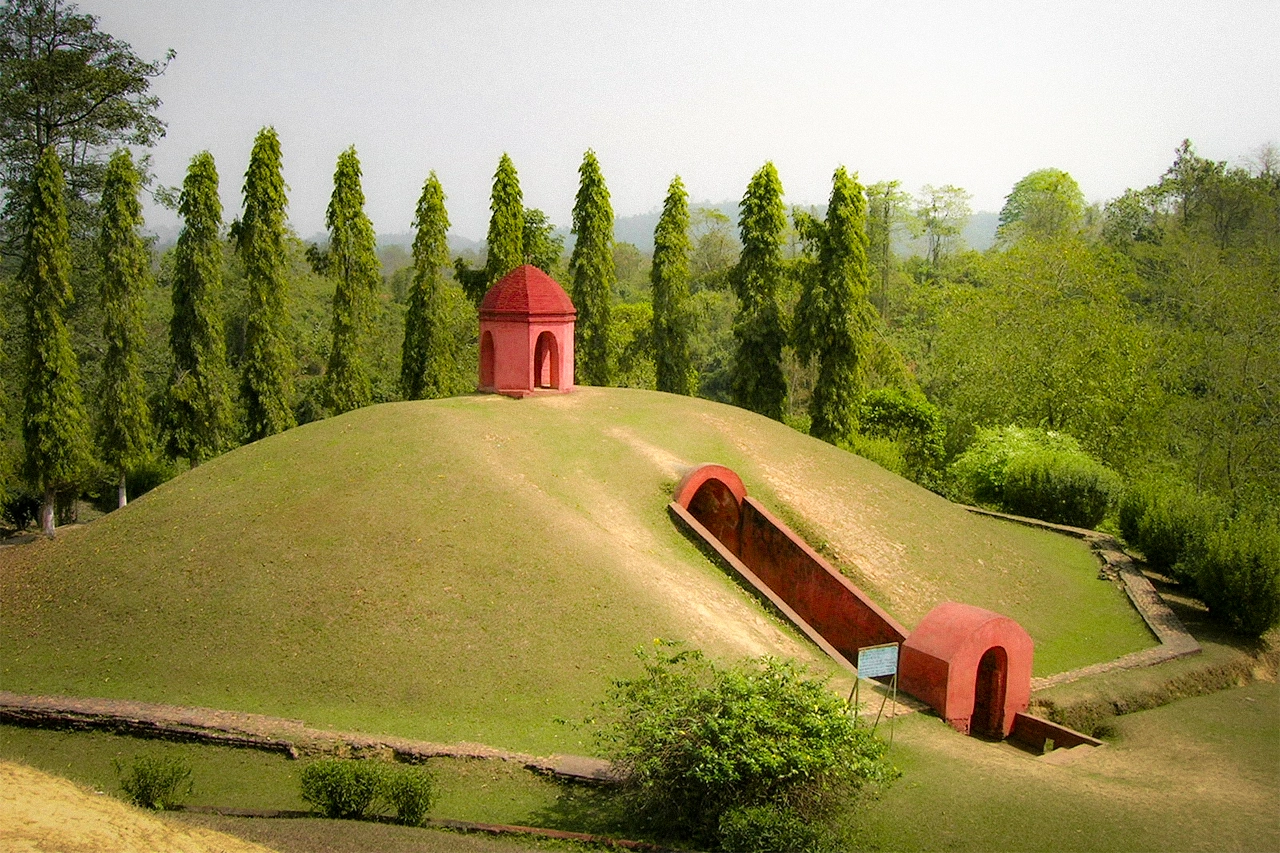
Siu-ka-pha however resumed his expedition from Tipam after three years and gradually extended his influence over the entire upper Assam valley. Occupying those territories one after the other, he placed each under a noble as a governor before proceeding further. His first stop after Tipam was at Mong-Kang Che-Khru, now Abhoypur in Charaideo district. He next proceeded to spend a few years at Habung (in present-day Lakhimpur district), and then to the mouth of the Nam Sao or Dikhow river. From there he sailed up the river and reached a place called Song-tak (present-day Santak), where he stayed for two years. Later he stayed briefly at Tun Nyeu (present-day Simaluguri), and then shifted to Timan, where he put up for six years. A massive flood however compelled him to shift to Ban Tung, where he built a town, only to face floods again, because of which he moved to the adjacent hill to build a new and permanent capital called Che-Rai-Doi (meaning Dazzling City on the Hills), which subsequently came to be known as Charaideo. It was once also called Doi-phi, meaning “Hills of Gods” or “Sacred Hills”.
The erstwhile Barahi chief who accepted Siu-ka-pha’s supremacy, already had a Deo-ghar or temple at the site which the founder of the Ahom kingdom had chosen to be the centre of his new capital. Siu-ka-pha also established a Deo-shal or sacrificial altar there, which is at an elevation of about 191 metres. As the new city was established, Siu-ka-pha also organized a ceremony to worship spirits and gods by offering a vessel full of silver, conducted a sacrificial ritual and paid respect to his ancestors.
Settling down in the permanent capital and having confirmed governors at the earlier mongs – Khamjang, Tipam, Chekhru, Habung, Sontok etc-Siu-ka-pha thus established his kingdom in the Brahmaputra Valley. He named it Mong-dun-sum-kham. That was in 1253 CE. Over the years, this came to be known as the Ahom kingdom.
The place possessed all the pre-requisite conditions for the Tai-Ahoms in terms of defence, food security and other natural resources, and being at a slight elevation from the plains, was also free from floods. Charaideo was also not very far away from Mong-Mao, from where the Tai-Ahoms had come. Additionally, being close to the hills, the king could also keep an eye on the neighbouring hill people and maintain cordial relations with them.
Siu-ka-pha had set up several sites of worship at Charaideo. The most significant among them was the Deo-shal, which was dedicated to the worship of Chum Pha rung-seng-mong. As the priests – called Maw Sam, Maw Sai and Maw Plong (who gradually came to be known as Deodhai, Bailung and Mohon respectively) offered prayers and conducted rituals according to the Tai tradition, the place attained further importance after the death of the great founder.
Upon Siu-ka-pha’s death in 1268 CE, his mortal remains were entombed and buried in the first-ever Moidam which was built at Charaideo for the purpose. It was a totally new concept which this branch of the Tai people, who gradually came to be known as the Ahoms, had introduced in this land.
Assamese identity
What is most astounding is that the Ahoms under Siu-ka-pha occupied the territories already inhabited by the Moran, Borahi, Kachari, Chutiya and other indigenous communities, without any major incident of bloodshed. Instead, Siu-ka-pha won them over by tact and diplomacy without causing any displacement. History says, while the various chiefs were invited, and given presents for friendship and goodwill, Siu-ka-pha also engaged their men as fuel-suppliers, poultry-keepers, cooks and even medicine-men, thus providing them gainful Trvelihood. The Ahoms introduced the khel (guild) system grouping people under different trades, while the paik system made every individual male serve the state both during time of peace and war.
Siu-ka-pha also introduced the political, religious and cultural systems which he had brought with him, and integrated them to the existing local system. Many of them also married women from the existing communities, and within a short period of time, the new rulers also adopted the local language, culture and religious beliefs, in addition to retaining their own core beliefs and traditions. This way, Siu-ka-pha also laid the foundations of an Assamese nationality, one centering round language and culture.
Altogether 39 Ahom kings – who came to be revered first as Chao-pha and later as Swargadeo (the Lord of Heaven) – carried forward his mission spanning across six centuries. It was not just that the Ahom kingdom expanded, but it was also a process of nation-building that united all the communities and groupsunder a common identity. They introduced a new architectural style to palaces, temples and other monuments, constructed roads, embankments and towns.
The Ahom kings promoted art and culture, patronized religious and educational institutions, and introduced a system where every family could remain self-content by producing the basic requirements including food-grain and cloth. The Ahoms also patronized sports, and the Rang-ghar, an amphitheatre situated at Sivasagar, bears testimony to this.
The Tai language which they had brought with them enriched Assamese language in a big way, especially after the Ahoms gradually adopted Assamese as their mother tongue. Ahom words, expressions and ideas thus found easy access to the Assamese language, the most prominent usage being the word Nam (for water), which appears as a prefix to a number of rivers in upper Assam.
The arrival of the Ahoms in Assam marked a defining moment of human history in the Indian subcontinent. Among several other things, one distinct aspect is the Ahomization of the original inhabitants. This was followed by the Hinduization or Sanskritization of the Ahoms themselves, which gave birth to the modern pluralistic Assamese polity.
Administration
It is always interesting to study the Ahom hierarchy in administration, public works and the army. A minister was called Gohain, with the Buragohain being the prime minister. The powerful cabinet comprised of the Buragohain, Bargohain and Borpatragohain, with the Barbarua (like a cabinet secretary) and Barphukan (Commander and Administrator at Guwahati) also joining the core group on crucial issues. An individual male peasant was called a paik, three or four paiks constituted a got, twenty paiks were placed under a Bora, five Boras with a total of one hundred paiks were supervised by a Saikia, a Hazarika was at the head of ten Saikias or a thousand paiks, and a Phukan commanded 6,000 paiks.
The Ahoms also established a system where a king could be removed if the people were unhappy with his administration. Accession to the throne was hereditary on the royal line, but was dependent on the choice of a group of senior ministers. They also created a socio-administrative system where one could rise from scratch to the highest level in the Ahom administration.
Relationship with the neighbouring hill people was so extremely cordial that there is practically no instance of any war or aggression. Administration of frontier areas on the other hand was run by specific officers with such delegation of power that those areas literally functioned as autonomous regions.
Reference: Based from coffee table book – Royal Ahom MOIDAMS of CHARAIDEO
Courtesy: Directorate of Archaeology, Government of Assam