
Moidams
The Mound-Burial System of the Ahom Dynasty
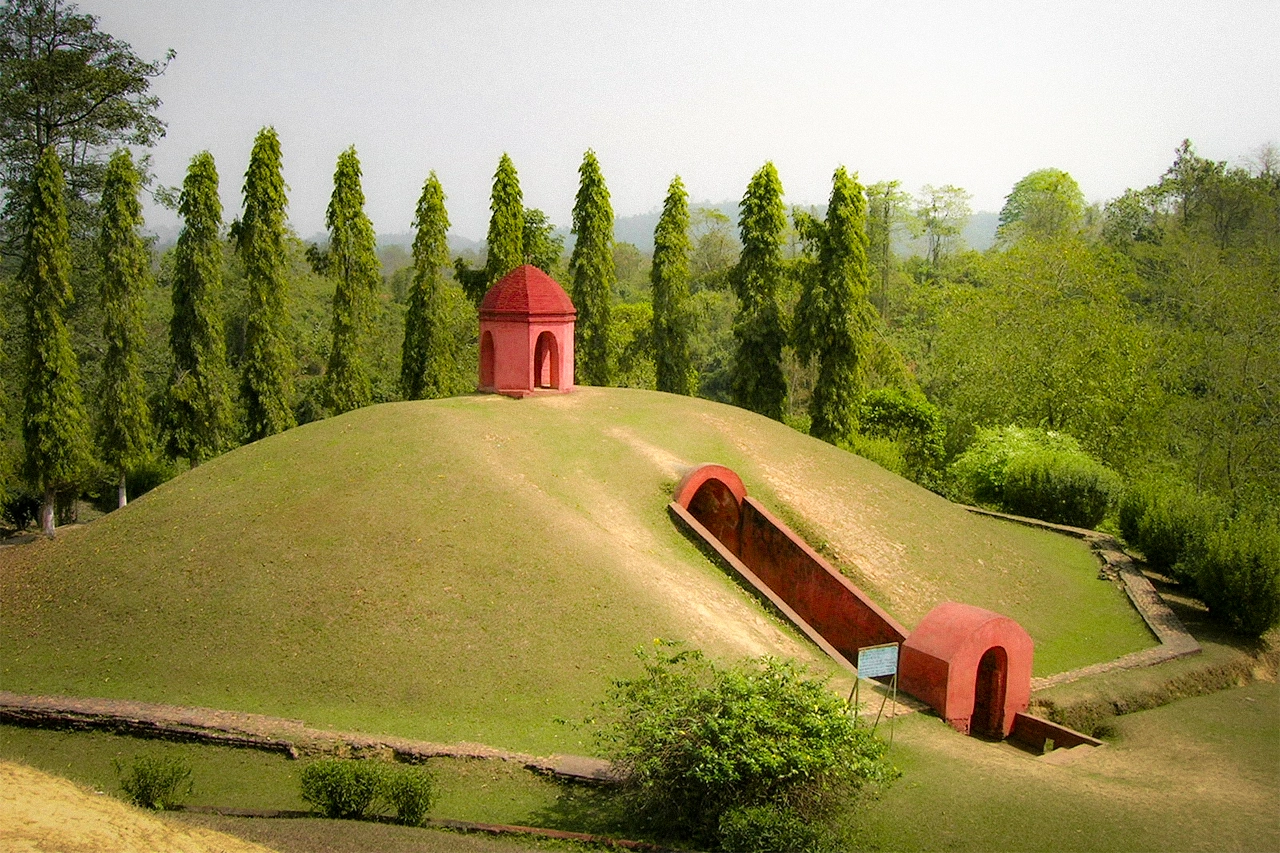
One of the most distinctive features of the Ahom rule and culture in Assam is their royal burial system, epitomized in the construction of a Moidam a hemispherical mound burial -as the final resting place for every Ahom king, queen, and, other Ahom royals.
The word Moidam has been derived from the Tai words Phrang Moi-meaning, to bury, and Dam – the spirit of the dead. Thus, a Moidam is where the spirit of the dead royalty is kept buried. According to Tai-Ahom belief, though the body perishes upon death, the soul continues to live on just as human beings do, in a world of pleasure, to be worshipped and commemorated by their descendants.
Though Moidams are found scattered across different parts of Assam, the highest concentration is to be found at Charaideo, the first capital of the Ahom dynasty. The first-ever Moidam was built at Charaideo for Siu-ka-pha after he died in 1268 CE. It was a totally new concept which this branch of the Tai people, who gradually came to be known as the Ahoms, introduced in this land.
Most of the 39 kings of the Ahom dynasty are said to be buried at Charaideo, which, in the process also became the royal necropolis of the Ahom kingdom. The place is about 25 kms east of the historic town of Sivasagar, and 380 km from Guwahati, the Assam capital. Two nearest airports are at Dibrugarh (88 km) and Jorhat (82 km).
As has been already mentioned, Charaideo means ‘Dazzling City on the Hills’ in the Tai language. While Siu-ka-pha had established the first capital of the Ahom dynasty at Charaideo, the capital was shifted to Charaguwa (1397 CE), Rangpur (1699 CE) and Jorhat (1788 CE). But continuing the tradition set by Siu-ka-pha, Charaideo was maintained as the royal necropolis till the end of Ahom rule, with the mortal remains of the royals being finally taken to Charaideo for the ceremonial burial. This made Charaideo the most sacred place for the Ahoms, and it became a convention for every king to visit the place to seek divine interventions.
Ahom philosophy of life after death
The Ahom system of mound-burials or Moidams is directly related to their concept of life after death. They believe that by death the body perishes, but the spirit or soul lives on with a finer body associated with certain human qualities. Thus, to the Tai-Ahoms, death is not annihilation. They thus consider the Tak or vault at the heart of the Moidam as a ‘momentary resting place’ for the Dam or dead. They also believe that the grave goods placed at the Tak serves the Dam for a period of 21 days. Once these 21 days are over, the Han or material element of the body is absorbed into the earth, and the Pu or spiritual element of the body when the royal person was alive makes its final journey to heaven to become a Phi. It is for the purpose of facilitating this journey of the Pu that the Chou Cha Li atop the Moidam is called Mungklang; it is the ‘middle space’ symbolizing a golden ladder which establishes the heaven-earth continuum.
The careful sculpting of mounds amidst natural uplifts, man-made ditches, dense foliage with the lofty Patkai range in the backdrop, is ethereal and nothing but an Ahom image of ‘heaven.’ With the myth of their origin referring to Lengdon sending his two grandsons Khun-lung and Khun-lai directly from heaven down a golden ladder strongly being embedded in Ahom mythology, it is but natural that the king was referred to and revered as a Chao-pha, later as Swargadeo – the Lord of Heaven!
Ancestor worship
The Ahoms strongly believe that their ancestors keep a constant watch on them from up above in the form of Dam and Phi. Since they believe that the spirit or soul lives on with a finer body associated with certain human qualities after the body perishes, ancestor worship is a cardinal feature of Ahom life. It is also regarded as a social duty and a sacred function.
While the manner of ancestor worship may differ from one Tai group to another, observing Me-Dam Me-Phi (ancestor worship) is the most sacred duty of the Ahoms. It is believed that Lengdon, while sending down to earth his two grandsons Khung-lung and Khun-lai, advised them to observe Me-Dam Me-Phi every year. That exactly is why Me-Dam Me-Phi continues to be the biggest form of ancestor worship.
Me-Dam Me-Phi was observed at Charaideo with elaborate rituals for several days during Ahom rule, during which various animals were also sacrificed. The present-day ritual however is a day-long affair, and no animal sacrifice is done except for fowls and ducks. As has been the tradition of the Ahoms to assimilate, several Hindu elements like invoking the gods and making certain offerings have also found place in the Me-Dom Me-Phi in the present time.
Buranjis record, Siu-ka-pha himself had performed the first Me-Dam Me-Phi ritual at Namruk immediately after descending from the Patkai to the Brahmaputra Valley. Thereafter, he performed the ritual in his newly-built palace at Charaideo in order to seek the blessings of his ancestors after setting up his first permanent capital. Following his death, his son Siu-teu-pha (1268-81 CE) observed Me-Dam Me-Phi at the Moidam of his father. Since then, every Ahom king observed it, barring Jayadhwaj Singha (Siu-tam-la, 1648-63 CE), whose defeat in the hands of the Mughal army led by Mir Jumla in 1662 CE is believed to have been an outcome of his failure to observe the ritual. Soon after Jayadhwaj Singha’s death, the first thing his cousin and successor Chakradhwaj Sighha (Siu-pung-mung) did was to observe Me-Dam Me-Phi at Charaideo, with buranjis noting that the great victory of the Ahoms over the Mughals at the Battle of Saraighat (1671 CE) was a direct positive outcome of it.
The Tarpan (libation of consecrated water) ceremony on the other hand is a later addition as the Ahom royalty began accepting Hinduism. In Tarpan, a priest sacralizes a bowl of water by uttering a prayer, after which he sprinkles the water on the ground as well as on the devotees.
Nominated Property
The Nominated Property encompassing an area of about 95.02 hectare has the highest concentration and most comprehensive clustering of 90 Moidams of different sizes. The Moidams are scattered within the Nominated Property and do not follow any particular spatial pattern. The components of a Moidam have been already described in a previous chapter.
The sacred landscape developed by the Ahom kings over a period of six centuries also stands within the Nominated Property. This landscape corroborates the image of a transcendental space called Mungklang in the Tai language. The Mungklang is considered to be the dwelling place of the Ahom kings who are considered to be gods, and are thus referred to as Swargadeo (the Lord of Heaven). The Ahom kings had also augmented the natural foliage of the area by planting a variety of trees considered sacred by the Tai-Ahoms. They include Khang-rung-rai (Aahat or sacred fig), Tun-rung-rai (Bar-gas or banyan), Uriam (West Indian cedar), to name a few.
There is also the Ancestral Spirit Forest within the Nominated Property, which the Tai-Ahoms believe is the place of a deity called Khi Thoun, and removing trees or plants from there is forbidden. Together with the natural foliage, the Ancestral Spirit Forest also presents a rich botanical wealth within the Nominated Property.
The Nominated Property also encompasses several water bodies, some of which are natural, and some man-made. The water-bodies have lotus-an aquatic plant-whose flowers, according to Tai-Ahom belief, symbolizes creation.
Within the Nominated Property also stands a small modern shrine at the entrance to the site, where Me-Dam Me-Phi and Tarpan are performed today. As these traditions and rituals continue even to this day, they make the Moidam landscape at Charaideo the most venerated of the royal Tai-Ahom burial architecture and tradition.
Buffer Zone
Surrounding the Nominated property is the Buffer Zone covering over 755 hectare of area. Within the Buffer Zone too exist some Moidams which include: a group of Moidams called Bali Moidams; another cluster called “Group of Moidams (so called Siu-ka-pha Moidam)”; a Moidam said to be of a queen known as Phuleswari Kunwari; four Moidams said to be other queens who are yet to be identified; and four other unidentified Moidams.
Additional archaeological remains within the Buffer Zone include some man-made pukhuri or ponds too. They include – (i) Petu-dhowa Pukhuri – where the intestines of the deceased were removed and washed, (ii) Sha-dhowa Pukhuri – where the body was ceremonially bathed, and (iii) Mitha Pukhuri – from where potable water was drawn, and others.
There is also a ceremonial pathway within the Buffer Zone, the Sha-niya Ali, which was used exclusively for the funerary procession. A portion of the historic Dhodar Ali also touches the Buffer Zone on the west. Other important archaeological remains of the first Ahom capital city which exist within the Buffer Zone includes that of a Rajabari (king’ residence), and the twin hills with remains of Deo-shal (sacrificial altar) and Gota Dole or Langkuri Doul at their top.
There are also a few tea estates within the Buffer Zone, apart from some sparsely populated villages which were settled in the recent past. The Buffer Zone essentially represents a rural landscape where one can see the customary way of Ahom life and traditions being practiced even today.
Architectural wonder
According to the Chang-rung Phukanor Buranji, a Moidam consists of five parts (i) Garvha the underground chamber, (ii) Tak-the vault, (iii) Ga-Moidam – the body of the Moidam, (iv) Dole or Chou cha Li-a small pavilion atop the Moidam, and (v) Garh – a low octagonal brick wall surrounding the base of the Moidam. In most cases, only the earthen mound, with heights varying from 0.3 metre to 20 metre is visible. The other parts are revealed only through archaeological investigations.
Excavations have revealed that the burial chambers are single-storeyed or rectangular, and are covered with a domical roof held in place by a keystone, with the wall of sufficient thickness. The chamber is accessible by an arched doorway. On excavation, it has been revealed that the burial chamber was meant to receive the deceased royal and various articles of personal use and need as burial goods.
The Moidams can be also placed under two categories from the construction point of view as the Tai-Ahom tradition underwent a major evolutionary stage. Moidams constructed till the 16th century were made of wood (posts of Nahar and planks of Uriam), bamboo and other vegetation materials to construct the burial vault in the chamber. Rudra Singha ((1696-1714 CE) introduced stone and bricks to build the chamber, which also led to increase in the inner space. The mortar for masonry works was called karal, and was prepared from a proportionate mixture of molasses, shell lime, limestone, edible lime, black lentils, hemp, barali fish (Wallago attu; a freshwater shark), duck’s eggs, bora chaul (glutinous rice), and brick powder etc.
There was no fixed size area, height, chamber, etc -for the Moidams. Thus, the height of the tallest Moidam is about 20 metres, while the smallest one has a height of just about 0.3 metre. But, as has been earlier mentioned, certain basic patterns were definitely followed while constructing a Moidam. The site for each Moidam is ceremonially selected, and the Moidams are sometimes clustered, and placed on an elevated land to form a wooded ‘hill-scape’.
Sacred landscape
The landscape of the Charaideo royal necropolis originally comprised foothills of the Patkai mountains having elevated land, forests and water all gifts of Nature. However, the Tai-Ahoms converted it into an Ancestral Spirit Forest as described in their ancient scriptures. This they did by constructing Moidams, planting sacred trees like the Bar-gas (Banyan tree), Uriam (whose wood were used for making royal coffins) and Sanchi (whose barks were used for manuscript writing) to make the existing natural foliage denser, and by channelizing streams and creating water bodies with lotus, the symbol of creation.
The scenic natural landscape underwent an amazing physical transformation with the ceremonial establishment of several clusters of Moidams – mound-burials within a period of six hundred years. While the surrounding base of each bigger Moidam has an octagonal wall called Garh, which symbolizes the Universe in Tai cosmology, the Moidam proper itself is a receptacle for the royal phi, the protector spirit of the Ahoms, thus illustrating the importance of a Moidam in the Tai-Ahom belief system.
With the passage of time, the Tai-Ahoms, in addition to their gradual assimilation with the local population, also began to embrace Hinduism step by step. It was during the reign of the eighth Ahom king Siu-dang-pha or Bamuni Konwar (1397-1407 CE) that the influence of Hinduism was first felt in the Ahom court. While the Siu-seng-pha (1603-41 CE), the 17th Ahom king, was the first to accept a Hindu name Pratap Singha, it was the 20th Ahom king Siu-tam-la or Jayadhwaj Singha (1648-63 CE) who is said to have formally accepted Hinduism. Though this did not affect traditional practice of rites and rituals of the Tai-Ahoms as a whole, some elements of Hinduism did trickle into the Tai-Ahom way of life. The most important change that was visible was the acceptance of cremation as a part of the funerary rituals. While the mortal remains of the first 32 kings up to Pramatta Singha (Siu-nen-pha, 1744-51 CE) were embalmed before being placed inside the Moidam, the 33rd king Rajeswar Singha (Siu-ram-pha, 1751-69 CE) was the first king whose mortal remains were consigned to flames, after which his ashes were ceremonially buried in the Moidam at Charaideo.
Outstanding Universal Value
The Moidams of Charaideo are a magnificent and awe-inspiring concentration of royal sacred mound-burial landscape which is exceptional across the world. It is a royal necropolis of the Tai-Ahoms, which possesses outstanding universal value. Following are some aspects of the outstanding universal value of the royal Ahom Moidams located within the Nominated Property at Charaideo.
Created by the Ahom dynasty, and spanning across six centuries from the 13th to the 19th the sacred royal mound-burial landscape of Charaideo conveys a distinctive and inimitable funerary tradition of the Tai-Ahoms.
The royal Moidams at Charaideo created a space where the Ahom kings became gods, thus symbolizing a heaven-earth continuum, which is so conscientiously memorialized through Me-Dam Me-Phi (ancestor worship) since the 13th century.
Me-Dam Me-Phi, the worship of ancestors, and particularly the departed kings who had attained the status of gods as per the Tai-Ahom belief, and the rituals associated with it have been a great continuity. This is of outstanding universal value.
The 95.02 hectare Nominated Property at Charaideo has the highest concentration of Moidams a place where the Tai-Ahom royals are buried. They are also the best-preserved examples of the royal mound-burials of the Ahom dynasty. The necropolis at Charaideo is also a rare, shared heritage of South and South-east Asia. The Nominated Property with 90 Moidams has the complete architectural, landscaping and spiritual expression of the original Tai belief-system.
On the death of a king

After the death of a king, the funeral arrangements generally take between one and three months. After a new king is nominated and announced, he passes an order for preparing the Moidam for the deceased king. While one team (headed by a Changrung Phukan) is dispatched to select a site and prepare a Moidam, another team takes care of the body of the deceased royal till the Moidam is ready.
A group of paiks led by a priest goes to Charaideo to select a site for the Moidam. The site selection method itself was interesting: an egg is thrown in the air, and if it breaks upon falling on the ground, that particular place is considered appropriate for a Moidam. If it doesn’t, then the process continues in other sites till the egg breaks at a particular spot. Once the site is selected, a handful of gold and silver pieces is offered as price for the plot, and it is sanctified by chanting a particular prayer.
The team holding charge of the deceased’s body removes the intestines and washes the body in a particular pond called Petu-Dhowa Pukhuri. It is then anointed with a paste of mati-maah (black lentil) and turmeric. The embalmed body is kept in a wooden coffin called Rung-dang made of planks of a particular tree called Uriam
(Bischofia javanica), which is painted with red and yellow hues prepared from two particular dye plants locally called hengool and haital. The Rung-dang is preserved at a place called Sha-thowa Nagar (town for keeping a corpse) or Gomotha Nagar till the Moidam is ready.
Once the designated Moidam is ready, the preserved body is dressed in royal attire and placed on a fine mat of gold and silver placed on a carpet. An embroidered pillow is also placed under the head. Close relatives place wreaths on the body to the chanting of certain prayers. The body would then be taken in a funerary by pall bearers belonging to two particular khels or guilds; the head side is held by men of the Gharphalia khel, while the lower side is held by men of the Lukhurakhan khel. As sword-bearers lead the procession, nobles, ministers, and close relatives join it. The Bailung – royal priest – chants some verses called Rik-khwan, to the beats of drums and music of pipes. Also integral to the procession are ten particular attendants they being – (i) Heng-dan-dhara – sword-bearer, (ii) Changmai – royal cook, (iii Tamuli attendant who serves betel nut to the king, (iv) Pachani messenger c the royal household, (v) Ga-chowa ligiri personal female attendant, (vi) Ligir male personal attendant, (vii) Dhonwakhowa-dhara tobacco-pipe bearer,viii) Chonwar-dhara – bearer of the yak-tail whisk, (ix) Joro-dhara – water-pot beares, and (x) Pikdan-dhara-spittoon bearer.
The body is then bathed at a pond called Sha-dhowa Pukhuri (pond for bathing the corpse). After this, it proceeds along a particular road called Sha-niya Ali (road exclusively meant for taking the corpse) to the designated Moidam. The coffin or Rung-dong, after being ceremonially carried to Charaideo, is placed, along with the bedstead, in the funerary chamber with the head towards the East. As the ten attendants take their designated positions, a number of artefacts are placed around the coffin. These include gold and silver utensils, a quilt, a silver mat, pillows with covers embroidered with gold threads, precious stones, cowries, the royal insignia carved on ivory, gold pendants, cannon balls, etc. After offering their last respects, as all others leave, the ten attendants and a person from the Lukhurakhan khel stay back, only to leave after a specified time. As the last group leaves, the opening to the chamber is closed. No one is supposed to look back while leaving the chamber. Earlier, the principal male and female attendants were also left behind in the chamber. This practice however was done away with by Rudra Singha in 1696 CE.
Once the burial rituals are complete and all come out of it, the entrance to the chamber is sealed with a thick wall of mud and/or lathia stones and bricks. Paiks then start working on the earthen mound over and around the chamber. Once the earthen mound is complete, a Chou Cha Li (a small temple-like pavilion) is built atop it, while a low octagonal brick wall is built around the base. An officer called Moidamiya Phukan was responsible for the maintenance and upkeep of the Moidams.
Desecration of Moidams
Unfortunately, the Moidams in Assam were desecrated several times between 1662 CE and 1854 CE, as mentioned in various sources. The Mughal army led by Mir Jumla which invaded Assam during 1662-63 CE, had dug up nine Moidams and removed valuables from there. The second time was in 1840 CE when the Assam Company (the world’s first tea company), which had set up its headquarters at Nazira near Charaideo, dug some Moidams and removed bricks to build the Company’s office and bungalows. There is also record of Purandar Simha (a tributary king of a small portion of the original Ahom kingdom centering round Jorhat from 1833 CE to 1838 CE) digging 13 Moidams in 1846 CE. Some Moidams were also reportedly leveled down and tea gardens established on them.
Protection & Management
The Moidams of the Ahom dynasty at Charaideo, which constitute the Nominated Property for consideration as a World Heritage Site, once upon a time belonged exclusively to the Ahom royals who meticulously maintained them. After the sun set on the Ahom kingdom in the early 19th century, the Charaideo necropolis fell out of use, and was thus left to Nature which protected it by converting it into a dense Forest, camouflaging the burial mounds with the Patkai foothills.
An archaeological area was identified and explored in the late 20th century, and rotection measures were initiated thereafter in the 1970s. The Nominated Property currently jointly managed by the Archaeological Survey of India and the Directorate of Archaeology, Government of Assam. Both agencies also protect the Nominated Property by prohibiting and/or regulating construction within the prohibited area and/or regulated area respectively, undertake exploration, excavation, conservation and preservation. Five Moidams meanwhile have been excavated, details of two of which have been given previously.
The conservation policy of both the agencies also ensures conservation and restoration works through specific annual repair plans and special repairs programmes. Since the Moidams of Charaideo attract a good number of tourists and visitors every year, the Department of Tourism (Government of Assam), has been promoting tourism centering round this site.
On the legal front, while the Ancient Monuments and Archaeological Sites and Remains Act, 1958, as amended in 2010 (a Central Act), has been in force over the “Group of Four Maidams” within the Nominated Property, and the Buffer Zone. The Assam Ancient Monuments and Records Act, 1959, has been in force in the Charaideo Archaeological Site (adjacent to the “Group of Four Maidams”) within the Nominated Property since 2015, as also in the remainder part of the Buffer Area.
While the Nominated Property has no inhabitants, the Buffer Zone has a population of a little over 4,000 persons as per the Census of 2011, all indigenous, who had settled there since the 1960s from adjoining villages as farmers. The site being sacred to the Ahoms, the community’s veneration itself works as the basic protective measure. This being a voluntary form of protection, the Government ofIndia and the Government of Assam have, over the years, taken a number of steps to involve the indigenous population in ensuring protection and preservation of the Charaideo necropolis and other Ahom sites in the Buffer Zone.
There is no impact of land ownership or rights to resources due to the process of nomination of the Moidams of Charaideo as a World Heritage Site. The local community, local government, private organizations and government bodies, who are all stakeholders in the property, have been made part of a consultation process. The basic demand which has emerged from this process is creation of livelihood opportunities, particularly in the tourism sector, and jobs likely to be generated in the site management process.
Archaeological research
Archaeological research has been carried out in the past several decades in the Moidams of Charaideo. The Archaeological Survey of India and the Directorate of Archaeology, Government of Assam, has been engaged at Charaideo since 1970, with the first formal identification of four mound-burials. Since then, activities like documenting, updating existing documentation of architectural drawings, photographic records and drawings with condition mapping of the Moidams and their component parts within the Nominated Property and Buffer Zone have been carried out in a systematic manner.
Excavations have been so far carried out in five Moidams Moidam 2, 38, 77, 78 and 90 all within the Nominated Property at Charaideo. These have brought to light certain details of the Moidam architecture and other components. While Moidam 2 was excavated by the Archaeological Survey of India, the other four were excavated by the Directorate of Archaeology, Government of Assam in different periods between 1988 and 2022.
Among them, excavations carried out in Moidam 2 during 2000-2003 and in Moidam 78 during 2021-23 have been the most noteworthy in understanding the inside of the burial chamber. The shell of the Moidam 2 was constructed of brick masonry and a few pieces of stones. The burial chamber was a hollow cuboid 5.35 metres in length, 4.40 metres in breadth and two metres in height, with the inner height of the dome measuring 5.05 metres from the floor. The entrance to the burial chamber had an off-centred arch 1.90 metres wide on the west. The dome shape was achieved by concentric circles of brickwork, held in position by a keystone at the apex. The earthen mound was thick-layered and secured with a double layer of brickwork, and the Moidam as a whole had a height of 9.15 metres at its apex. Bricks used in constructing the Moidam’s vault had varying sizes, while the walls were plastered with lime-surki (brick dust) mortar, which gave strength and additional stability to its construction. There was a blind hole on the upper edge of the wall for inserting an iron nail, while some large stones were used at the lower corners of the Moidam to support the walls. The Moidam entrance was sealed by a 50 cm wall of brick masonry, joined with iron clamps, and a heap of stones was placed against the wall in order to further block the entrance.
The excavation at Moidam 2 led to discovery of five human skulls. Four of these skulls were of females, and the fifth, a male, believed to be that of a deceased king who was in his forties. The position of the skulls also confirmed the Ahom practice of placing the head of the deceased towards the east direction for paying homage to their ancestors who came from the east. Human bones of hips, radius ulnas, ribs, knee-caps and phalanges etc were also found during the excavations.
A report prepared by the Laboratory of Physical Anthropology and Ethnology, Bangkok (Thailand) has assigned the cause of death to a pestilence, an accident or a custom of burying living persons with the dead king. A DNA study of human skeletal remains from Moidam 2 and of 10 modern-day Ahoms was conducted by the Birbal Sahni Institute of Palaeo-sciences, Lucknow (UP, India). The samples show a close relationship with the Southeast Asian population, while those of the modern-day individuals suggest genetic architecture similar to the Indo-Tibeto-Burman population of Northeast India. From the study it may be deduced that the Tai-Ahoms who might have come from Southeast Asia later admixed with the indigenous population of Northeast India.
Other items found inside Moidam 2 included a terracotta plaque having a mythical dragon figure and floral motifs, an ivory panel with the mythical dragon – the Ahom royal insignia, ivory buttons and other ivory pieces with floral motifs, some gold pendants, iron hooks and pins, cowries, cannon balls, ceramic assemblages, etc.
Excavation at Moidam 78 too has brought to light certain interesting aspects of the royal Ahom mound-burial system. One of the largest mound-burials at Charaideo, it is about 11 metres high and has a diameter of 53.80 metres. Like any other large-sized mound-burial, Moidam 78 also has five principal architectural parts – (i) the Ga-Moidam or main earthen mound, (ii) the Chu Cha Li atop it, (iii) the Garh or octagonal dwarf wall, (iv) the Tak or burial vault, and (v) the Garvha or grave-pit. Moidam 78 also has a row of cobblestones on the ground marking its outer circular periphery.
Excavation led to a single-chambered Tak or burial vault was made of bricks, which was sealed by a double layer of fired brickwork. The brick wall of the Tak was 2.98 m thick, and was set in lime mortar. The entrance to the chamber was an arched passageway which was 1.90 m wide and 1.72 m high, was on the western wall of the vault. Bricks used in constructing the Tak had varying sizes.
The entrance passageway to the Tak was found completely blocked with a heap of medium- and large-sized cobbles (called Lathia sil) which were collected from the bed of a nearby river. Removal of the heap of cobbles during excavation led to a single-brick wide wall that completely enclosed the inner side of the entrance passageway.
Excavation also revealed that the Tak or burial vault of Moidam 78 was squarish, measured 4.73 metres in length and 4.25 metres in width, with the height of the side walls being 2.26 metres. These walls support a hemispherical dome raised by circles of brickwork receding toward the top and finally held in place at the apex with a central keystone. The internal height from the floor to the central keystone measured 4.87 metres. The floor of the Tak was made of bricks. There were three post holes at three corners, the purpose of which could not be ascertained.
The mostimportant discovery of the excavation of Moidam 78 was that the interior of the Tak was coated with fine lime plaster. Another significant find was a set of six iron hooks vertically aligned at the lower section of the hemispherical dome where the dome joins the walls. The iron hooks were evidently used for holding a multi-layered cloth canopy (a Chandratap) which is normally put over an altar or a throne, marking an authority. In this case, a multi-layered canopy must have been placed over the deceased Ahom royal, thus also indicating that Moidam 78 is associated with a powerful Ahom king.
A number of iron nails, aligned both vertically and horizontally, were found covering all four face walls of the burial chamber. These nails appear to have been used to hold some cloth of honour hanging from the top and support some wooden racks to keep certain articles which were part of the burial goods.
Excavation of Moidam 78 also led to recovery of certain human skeletal remains. These included two clavicles or collar-bones, one tibia, one scapula, one rib, one radius-ulna, one fibula, a human jaw and human teeth.
The list of antiquities recovered from Moidam 78 included some leaf-shaped pendants made of very thin gold sheet, fragmentary musical anklets, decorative ivory buttons, iron nails, damaged pieces of wooden planks secured with copper sheath, etc. Different types of pottery shapes, mostly rims of bowls of both coarse and medium fabric have also found in Moidam 78.
Siu-ka-pha Archaeological Museum
As has been already mentioned, the Archaeological Survey of India and the Department of Archaeology, Government of Assam, have carried out excavations in a few select Moidams at Charaideo. A site museum called Siu-ka-pha Archaeological Museum has been set up within the protected boundary of the Charaideo Moidams Archaeological Site in 2023 in order to showcase the excavated findings.
The Museum has on display a number of important objects recovered during the excavations. These include one male human skull, four female human skulls, a terracotta plaque depicting the figure of a mythical dragon (the royal Ahom insignia) and floral motifs etc, several decorated ivory pieces, ivory buttons and other pieces with floral motifs, an ivory panel showing the mythical dragon, pieces of copper objects fixed in woods, iron hooks and pins, cowries, gold pendants, cannon balls, one round wooden object (bedstead leg), and ceramic assemblages of deluxe variety, etc.
There are also facilities for providing certain basic information to visitors through photographs, drawings and diagrams.
Do’s and Don’ts
Please support us in keeping the site as a “No-Plastic zone“.
- Do’s
- Help in keeping the site clean.
- Maintain distance from the wall of the Monument and Sculptures
- Help in preventing and avoiding any kind of destruction of the site by anyone. Report any such matter to the concerned staff.
- Help in creating awareness in favour of the Cultural Property.
- Help in maintaining in sanctity of the site.
- The site is open for visitors from 9:30 AM to 5:00 PM.
- Don’ts
- Do not scribble/Engrave/write on the monument.
- Do not litter the Site/monument complex.
- Do not climb the sacred mounds.
- Do not touch the Monument, Walls or Pillars.
- Do not pluck flower.
- Do not carry or consume Eatables, Alcohol, Drugs, Tobacco, Gutka/pan masala, Cigarette etc. inside the Site.
Charaideo Moidam
Visiting Hours and Ticketing
- Visiting Hours
- Moidams – the Mound-Burial system of the Ahom Dynasty at Charaideo is “open throughout the year” for visitors.
- Please note it takes around “2:30 hours to have a complete tour” of the site.
- In order to have a pleasant experience, we recommend wearing comfortable shoes.
- The site is open from 9:30 AM to 5:00 PM
- Ticket Counter
- Tickets are available at the ticket counterlocated outside the main gate of the site. Parking facility for the visitors are also available.
- At present “tickets are only available in offline” mode for visitors.
- The ticket counter “closes 30 mins” before the closing of the site.
- No entry fee for children and students till “class XII”.
Reference: Based from coffee table book – Royal Ahom MOIDAMS of CHARAIDEO
Courtesy: Directorate of Archaeology, Government of Assam